Same engines
The native runners themselves
Kiln calls llama.cpp, stable-diffusion.cpp, acestep.cpp and yue2.cpp directly: the same C/C++ engines the CLIs and servers use, so you get their speed and their model support.

Open generative models for the JVM
Call models as plain Java methods, on your GPU, inside your JVM.
NewKiln Studio: try the models without writing codeEarly · Apache 2.0 · a Liberation Data project
Zero overhead
Straight from the JVM to the GPU.
Kiln runs open-weight models for text, images and songs in-process, through Java’s Foreign Function & Memory API. A model is an object, a generation is a method call, and the weights stay on your GPU between calls. There is no Python, no model server, no HTTP, no JSON round trip and no second process.
Same engines
Kiln calls llama.cpp, stable-diffusion.cpp, acestep.cpp and yue2.cpp directly: the same C/C++ engines the CLIs and servers use, so you get their speed and their model support.
Vulkan today
Vulkan on AMD, Intel and NVIDIA. The same build script knows ROCm, CUDA and Metal, and your Java code doesn’t change when you switch.
One process
A Kiln call is a native function call. Weights stay resident between calls, and tokens stream back to a Java callback as they are produced.
Plain Java
Open a model in a try-with-resources block, call it as often as you like, and close it to give the memory back.
AutoCloseable: weights are freed on close().System.out::print.chatJson: OpenAI-style messages and tools in, tool_calls out.BufferedImage.// The weights load onto the GPU once, and stay there until close()
try (var llm = new LlamaModel("Qwen3-4B-Instruct-2507-Q4_K_M.gguf")) {
// Tokens stream to your callback as they are produced
llm.chat(List.of(Message.user("Name a country song about a robot.")),
Options.DEFAULT, System.out::print);
}// OpenAI-style messages and tools in, an OpenAI-style message out
String res = llm.chatJson("""
{"messages": [{"role": "user",
"content": "What's the weather in Nashville right now?"}],
"tools": [{"type": "function", "function": {
"name": "get_weather", "description": "Current weather for a city",
"parameters": {"type": "object",
"properties": {"city": {"type": "string"}},
"required": ["city"]}}}],
"temperature": 0, "max_tokens": 128, "seed": 1}""",
null); // or a callback, to stream
// res has content, reasoning_content and tool_calls:
// here, finish_reason "tool_calls" and get_weather for Nashvilletry (var songs = new AceStepModel(lm, textEncoder, dit, vae, true)) {
songs.generate(requestJson).audio().writeWav(new File("song.wav"));
}try (var images = new DiffusionModel(DiffusionModel.Config.builder()
.diffusionModel(flux).vae(vae).llm(textEncoder).build())) {
BufferedImage img = images.generate(
new DiffusionModel.Request("a neon sign", 1024, 1024, 20, 4.0, 7)).get(0);
}Kiln doesn’t download anything: HfCache finds weights in your Hugging Face cache, or pass file paths.
Engines and models
Each module binds one engine. Use one, or put several in the same JVM.
Text
on llama.cpp
Any GGUF language model.
Images
Diffusion models, including image editing.
Songs
on acestep.cpp
Songs with vocals and lyrics, up to several minutes long.
Songs
on yue2.cpp
Songs, from the engine’s own JSON request.
Check each model’s license before you use what it makes. Some are non-commercial: YuE2’s weights are CC BY-NC 4.0, for example.
Measured
Everything here ran from Java on Linux, on an AMD Radeon 8060S (Ryzen AI Max+ 395 “Strix Halo”, 128 GB unified memory) with the Vulkan backend.
Backends:
The build script knows the ROCm, CUDA and Metal backends of the underlying engines, but those Kiln builds haven’t been tested yet. Reports and fixes welcome.
| Model | Result |
|---|---|
| Qwen3 4B Instruct (Q4_K_M) | ~60 tokens/s |
| ACE-Step 1.5 XL turbo | 3 min 20 s song in 57 s |
| ACE-Step 1.5 turbo | 60 s song in ~15 s |
| YuE2 3B (Q8_0) | 60 s song in ~60 s |
| FLUX.2 [klein] base 4B (fp8) | 768×768, 12 steps in ~130 s |
| Qwen-Image 2512 (fp8) | 1024×1024, 20 steps in ~13 min |
Against ComfyUI
ACE-Step 1.5 turbo with its 4B LM, writing a 60 s song, on the same machine. Cold is the first run with nothing loaded, weights included. Warm is the second run with the weights resident (seed + 1, so ComfyUI doesn’t return its cached result).
Not quite like for like: ComfyUI ran the bf16 safetensors DiT, Kiln the GGUF Q8_0 weights. One run each, from kiln-bench.
Kiln Studio
Kiln Studio is a desktop app around Kiln: chat with a GGUF model and watch the tokens per second, watch it call tools, make an image or a song, and see what is loaded and how much memory it holds. It runs Kiln in a JVM of its own, with its own Java, and finds the models in your Hugging Face cache.
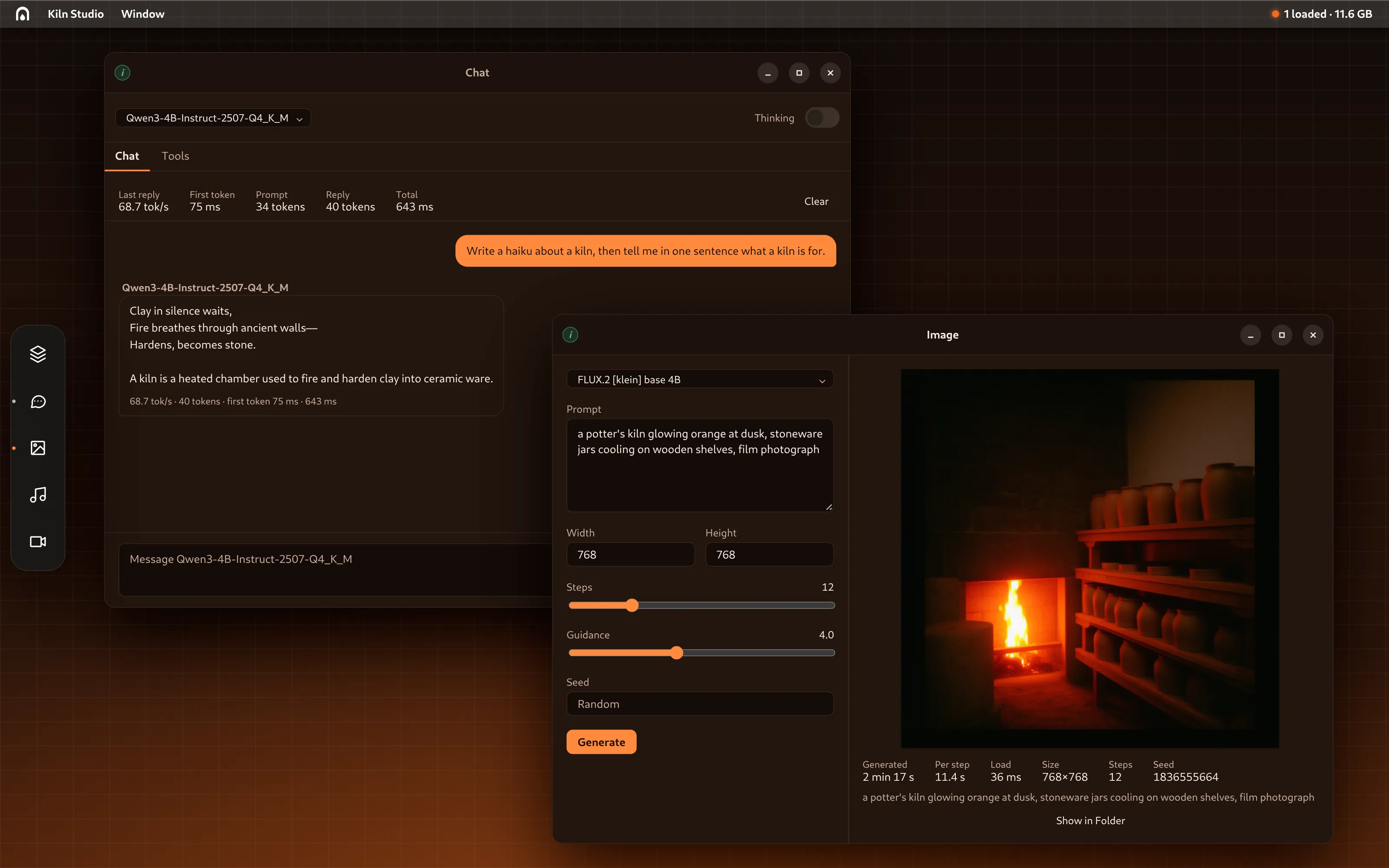
Builds for macOS (Apple silicon and Intel, signed and notarized) and Linux are on their way with the first release.
How it works
Each engine is built into a single shared library with its own ggml linked in statically and kept private. The engines pin different ggml versions, and this is what lets several of them share one process.
Has a key/value C API, so kiln-sd binds it directly.
Its C API passes structs by value and is mid-migration to a new batch API, so kiln-llama binds a small, stable C layer instead.
C++ only, so each gets a C layer of about a hundred lines: a JSON request in, PCM audio out.
LlamaModel.chatJson takes messages and tools in OpenAI’s format and returns a message with content, reasoning_content and tool_calls. It uses the model’s own chat template and tool-call format, with the same templates and parsers as llama-server.
Keeps models resident between uses, the way ComfyUI does. It unloads idle models least recently used first to stay within a memory budget, can unload after an idle timeout, and gives each model one user at a time.
The Java is the same for every backend. native/build.sh builds the libraries for the one you name.
A long GPU dispatch can trip a laptop driver’s compute timeout, so ACE-Step audio is decoded in 512-frame tiles. Tune it with KILN_ACESTEP_VAE_CHUNK.
Set KILN_VERBOSE=1 to see what llama.cpp, stable-diffusion.cpp and friends print.
Getting started
You need JDK 25, CMake, Ninja, a C++17 compiler and the SDK for your GPU backend. For Vulkan on Fedora:dnf install vulkan-headers vulkan-loader-devel glslc spirv-headers-devel.
native/build.sh clones the engines at their pinned commits and writes the libraries to build/native/<os>-<arch>-<backend>/. Pick another backend for Gradle with -Pkiln.backend=hip.
native/build.sh vulkan     # or hip | cuda | metal | cpu; optionally list engines: llama sd acestep yue2
./gradlew buildWith the Hugging Face CLI. HfCache finds them in HF_HUB_CACHE, HF_HOME/hub or ~/.cache/huggingface/hub.
hf download unsloth/Qwen3-4B-Instruct-2507-GGUF Qwen3-4B-Instruct-2507-Q4_K_M.gguf
hf download Serveurperso/ACE-Step-1.5-GGUF acestep-5Hz-lm-4B-Q8_0.gguf Qwen3-Embedding-0.6B-Q8_0.gguf \
    acestep-v15-turbo-Q8_0.gguf vae-BF16.gguf
hf download black-forest-labs/FLUX.2-klein-base-4b-fp8 flux-2-klein-base-4b-fp8.safetensors
hf download Comfy-Org/flux2-dev split_files/vae/flux2-vae.safetensors
hf download Comfy-Org/z_image_turbo split_files/text_encoders/qwen_3_4b.safetensorsThe song examples take the engines’ own JSON requests; pass your own as a second argument.
./gradlew single    # an LLM writes a song, ACE-Step sings it, FLUX.2 klein paints the cover
./gradlew chat --args='"Write a haiku about a kiln"'
./gradlew song --args='song.wav'                         # -Pdit=xl-turbo for the larger model
./gradlew yue2 --args='yue2-song.wav'
./gradlew image --args='klein out.png "a neon sign that says KILN"' -Psteps=12 -Pwidth=768 -Pheight=768Put the libraries on -Dkiln.library.path (or KILN_LIBRARY_PATH, or the platform loader path) and allow native access.
java -Dkiln.library.path=build/native/linux-x86_64-vulkan \
     --enable-native-access=ALL-UNNAMED -jar your-app.jar
Roadmap
kiln-embabel: an Embabel Agent LlmService and LocalModelSource.mtmd.mlx-c.Flow streaming.Open models as Java objects, on your own GPU. Kiln is early: try it, and tell us what breaks.